Barking Past · Breed dossier 021
Miniature Schnauzer
Montgomery County Kennel Club, 1 October 1939. A judge has just sorted a ring of Miniature Schnauzers. A week later, writing from memory, he warns their breeders not to breed for looks alone. [1]
Forged in function
The barn before the show ring.
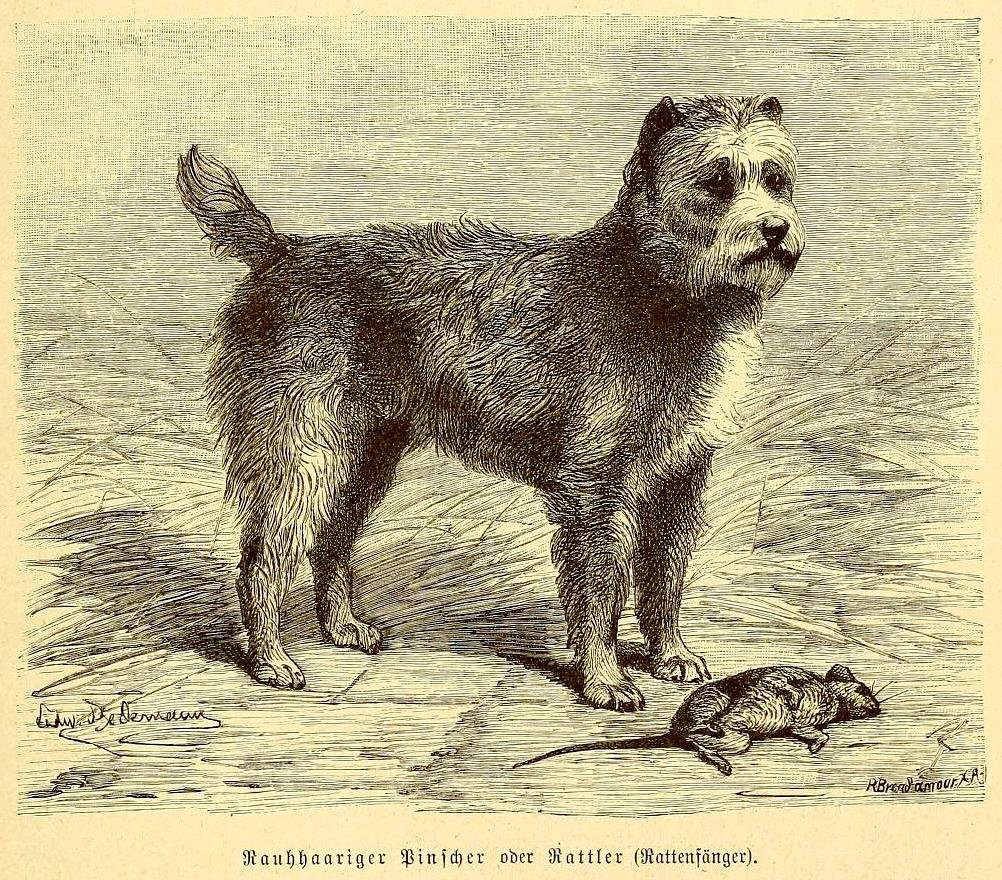
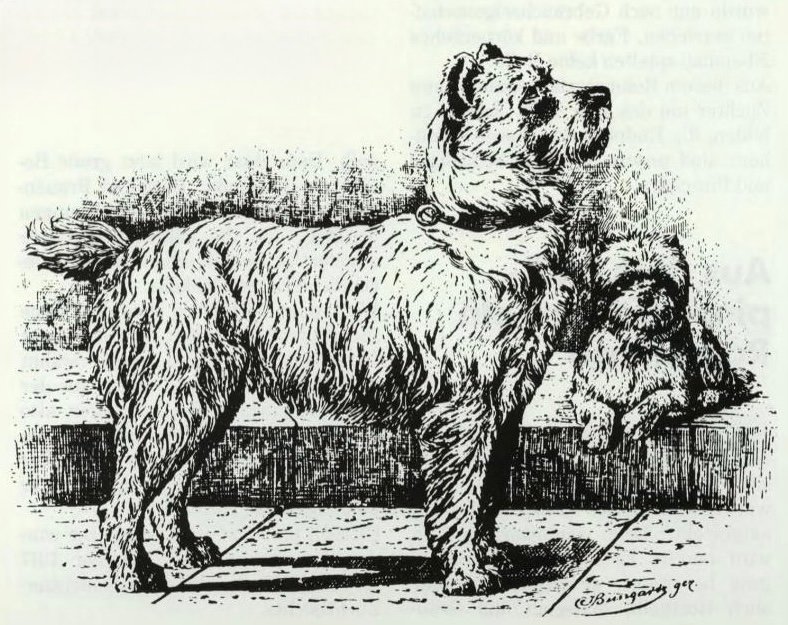
The AKC’s breed history describes German farmers wanting a smaller, compact dog to chase rats, voles and other rodents in house and barn, and lists small Standard Schnauzers, Miniature Pinschers, Affenpinschers and Miniature Poodles among its ancestors. No surviving record gives an exact recipe, so that list is later breed history rather than a documented breeding plan. [2]
According to the AKC, the first Miniature Schnauzer registered in Germany was a black female named Findel, born in 1888 and owned by Max Hartenstein of the Plavia Kennels. The account gives her birth year; it does not establish that she was registered in that year. [2]
Across the Atlantic
Marienhof and the first classes.
W. Goff imported the first two Miniature Schnauzers to the United States in 1923, but they did not produce enough puppies to establish the breed. Marie Slattery had better luck: she received four dogs from Germany in 1924, and her Marienhof Kennels bred the first American litter a year later. [2]
The American Miniature Schnauzer Club’s history dates AKC recognition, and the first registrations, to the fall of 1926. Separate classes followed in February 1927 at the Combined Terrier Clubs specialty, where the Miniature Best of Breed was Don v. Dornbusch, a German Sieger and later an American champion. [1]
A club divides
One breed or two?
Standards and Miniatures shared a national club, and the rules kept shifting. Until 1931 each breed had its own Best award; then only one Best was allowed until spring 1933. Billy v.d. Zonnenheuvel won Best of Breed at Oyster Bay in 1931. In 1932, with the breeds combined, Patricia was Best of Winners. In 1933, with separate awards restored, Mehitabel of Marienhof III took Best of Breed at Morris and Essex. [1]
When the Stud Book then declared that a specialty club should cover only one breed, the old Schnauzer Club of America was dissolved and separate clubs were formed. The club history gives 19 August 1933 as the formation date. At the new club’s first specialty, held with the Western Specialty Club in Chicago, Best of Breed went to Porgie of Marienhof, bred and owned by Marie Slattery. [1]
A judge’s warning
Breeding for beauty.
On 1 October 1939, Joseph C. Quirk judged the club’s specialty at the Montgomery County Kennel Club show. His critique, reproduced in the club history, admits he wrote from memory a week later, having taken no notes. He was struck by how consistent the breed had become, and Best of Breed went to an American-bred dog, Minquas Marko. He also singled out Marie Slattery’s T.M.G. of Marienhof as a sire stamping the breed with quality. [1]
His main concern was structure: straight hindquarters and bodies too long in the back. He also warned against short necks and profuse whiskers, which he linked to soft coats. “So many breeds have come to grief through breeding for beauty,” he wrote. It is a judge’s opinion from 1939, not a veterinary finding. [1]
With war under way in Europe, Quirk told breeders they had enough good bloodlines in America to carry on without importing new dogs. [1]
Living with the history
Health, care and the right home.
Screening the club recommends
The American Miniature Schnauzer Club’s board-approved recommendations (9 July 2024) call for an annual specialist eye examination registered with OFA and a cardiac evaluation. DNA tests for myotonia congenita, Mycobacterium avium complex and PRA Type B (HIVEP3) are listed as optional but recommended. [4]
What a PRA test can and cannot say
The University of Minnesota’s canine genetics lab notes that dogs have several forms of PRA. Its HIVEP3/PPT1 test covers one type, reported as the most common in the breed, so a clear result does not rule out every cause of vision loss. [5]
Best owner
Someone who enjoys a bright, busy small dog and will keep up grooming, training and the screening conversation with breeders and veterinarians.
Worst mismatch
A home that chooses the beard and the size but expects a farm ratter to need little activity or training.
Prints & provisions
The Kit
The Medallion
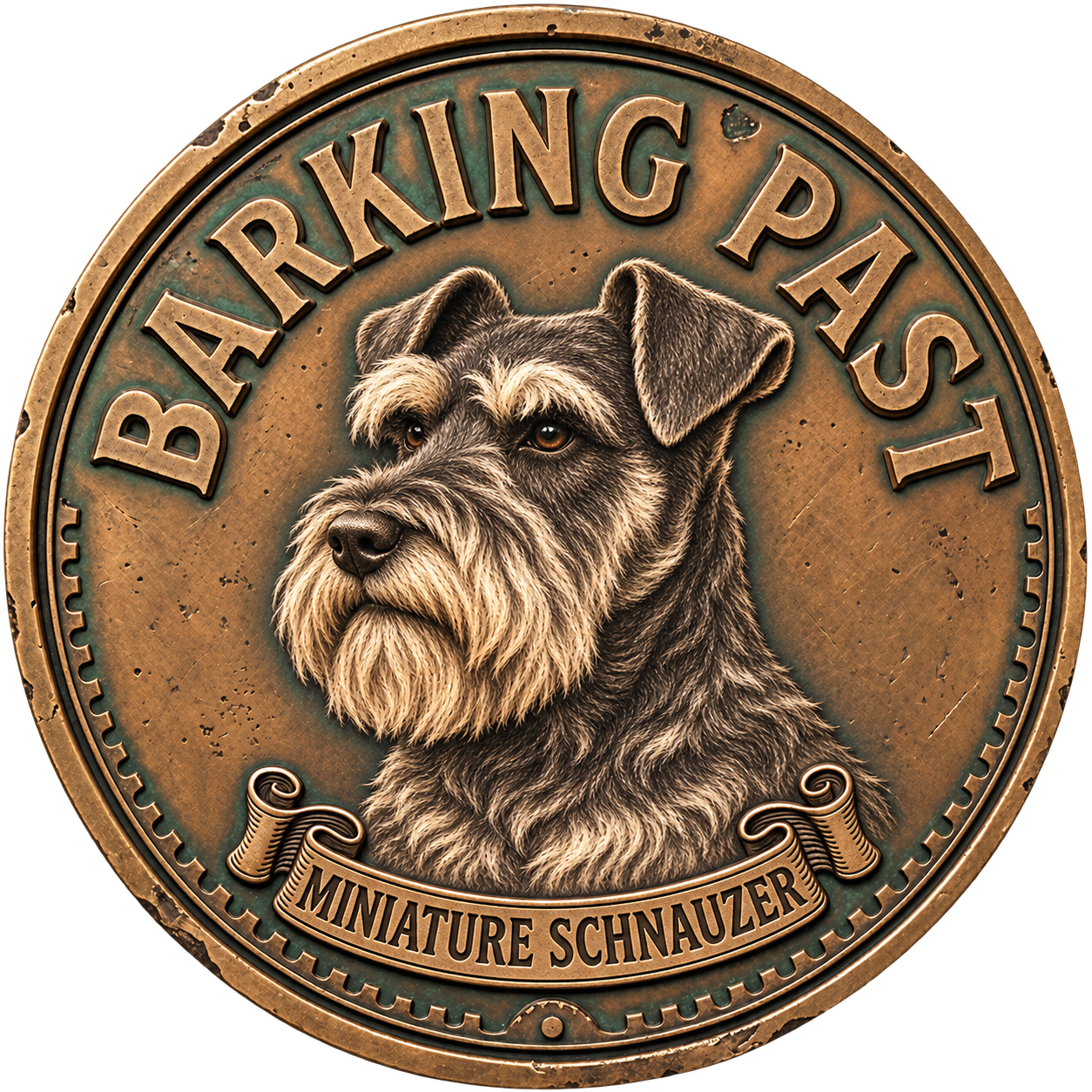
A matching T-shirt is not yet available to order.
As an Amazon Associate, Barking Past earns from qualifying purchases. Affiliate purchases may earn us a commission at no additional cost to you. This page is general breed information; discuss your own dog’s health with your veterinarian.
Sources & further reading
- American Miniature Schnauzer Club — A History of the AMSC, 1933 to 1995
- American Kennel Club — Miniature Schnauzer history
- American Kennel Club — Miniature Schnauzer breed guide
- American Miniature Schnauzer Club — Canine health topics and recommended testing
- University of Minnesota Canine Genetics Lab — Miniature Schnauzer health panel
From the archive
Plates & context