Barking Past · Breed dossier 022
Pomeranian
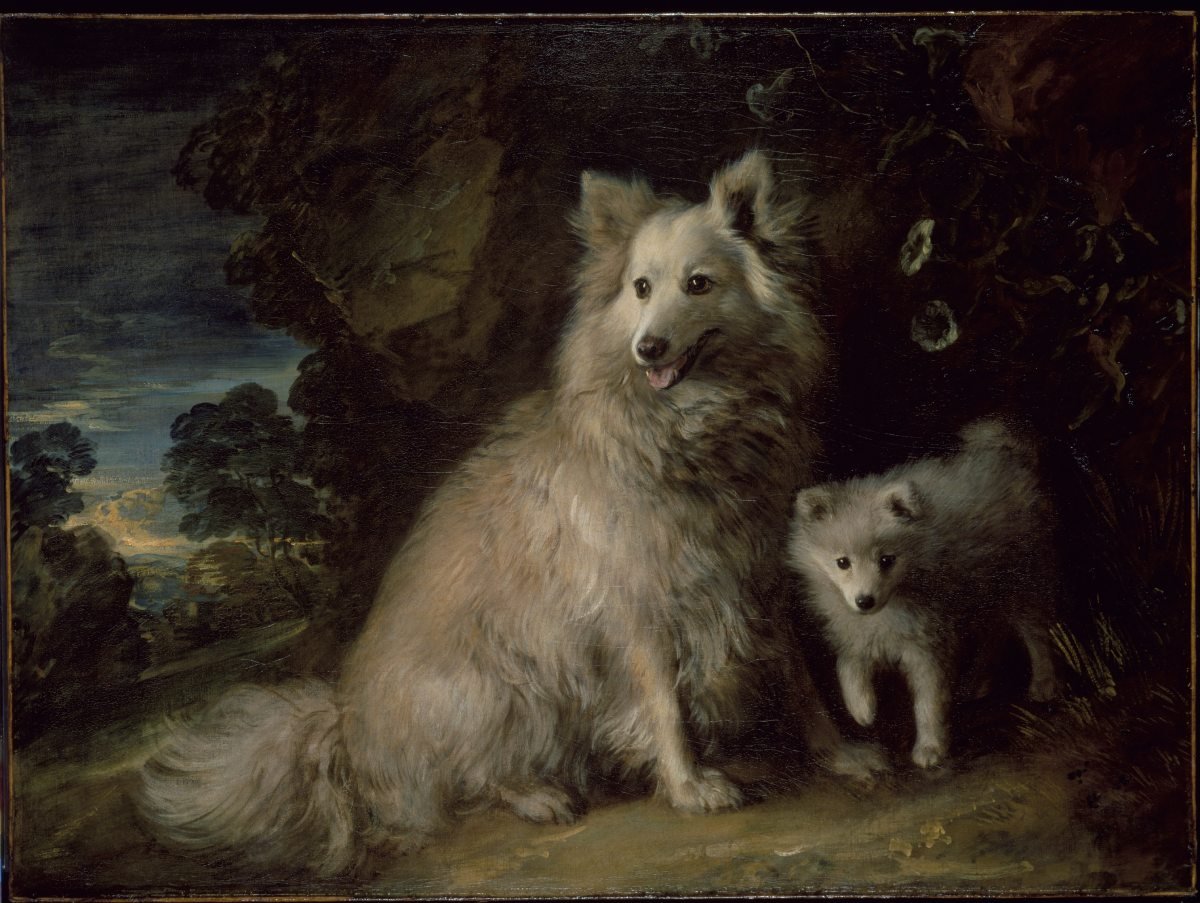
1893. The painter Charles Burton Barber pictures Marco, Queen Victoria’s Pomeranian, standing on the royal breakfast table. [3]
The unvarnished verdict
A royal companion, on the record.
The Pomeranian’s royal story is unusually well documented: named dogs, dated photographs and paintings, and a queen who showed her dogs at the first Crufts. Claims of an exact Arctic pedigree, or of a queen who single-handedly halved the breed’s size, are much harder to support. [1] [4]
A regional name
Spitz family, not a pedigree.
The AKC places the Pomeranian in the spitz family and says it is named for Pomerania, now divided between Poland and Germany, possibly because the breed was being downsized there rather than because it began there. Breed histories link it to Arctic sled dogs. That is a family resemblance, not a documented line of descent. [9]
The queen’s first Pom
Marco, from Italy.
The Royal Collection identifies Marco as the first Pomeranian Queen Victoria acquired, adopted in Italy in 1888; a photograph shows him as a puppy that year. He was photographed again at the Royal Kennels, Windsor, in 1890. [1] [2]
Marco was more than a kennel dog. Charles Burton Barber’s 1893 painting shows him on the breakfast table, and a portrait by Frances C. Fairman from about 1897 records him again. [3] [10]
The American Pomeranian Club adds that Victoria also imported a small white female named Gena. Individual show results for Victoria’s dogs have not been checked against original records here. [6]
Travelling companions
Turi at Cimiez.
A photograph from March 1899 shows a landau outside the Hotel Regina at Cimiez carrying Turi, another of Victoria’s Pomeranians, with three members of the royal household. It places Turi in the household’s travels, not only at Windsor. [5]
Stories about Turi at the Queen’s deathbed are widely repeated. This dossier has not verified them, so they are left out.
Across the Atlantic
Four milestones, not one.
The AKC lists the Pomeranian among the breeds first registrable in 1888. According to the American Pomeranian Club, Pomeranians appeared in Miscellaneous classes from 1892, but regular classification at New York came only in 1900, the year the club was formed. [7] [6]
In 1909 the club became an AKC member club and the breed’s parent club. Its first specialty, in 1911, drew 262 Pomeranians, with Ch. Banner Prince Charming as Best of Breed, according to the club’s own history. [6]
Living with the history
Health, care and the right home.
The club’s screening list
The American Pomeranian Club’s current page requires a cardiac evaluation, a veterinary patellar luxation evaluation and one elective: an ACVO eye examination registered with OFA, or an autoimmune thyroiditis test. Hip and Legg–Calvé–Perthes evaluations are optional but recommended. Screening is a framework, not a guarantee of health. [8]
Small, not simple
The AKC gives 6–7 inches, 3–7 pounds and 12–16 years as a breed guide. A small dog still needs training, social experience and regular coat care. [9]
Best owner
Someone who wants a lively, alert small companion and will keep up training, coat care and veterinary checks.
Worst mismatch
A home that expects a tiny, fluffy dog to need no training, no grooming and no attention to barking.
Prints & provisions
The Kit
The Medallion
A matching T-shirt is not yet available to order.
As an Amazon Associate, Barking Past earns from qualifying purchases. Affiliate purchases may earn us a commission at no additional cost to you. This page is general breed information; discuss your own dog’s health with your veterinarian.
Sources & further reading
- Royal Collection Trust — George Piner Cartland, Marco as a puppy, 1888 (RCIN 2940367)
- Royal Collection Trust — Marco at the Royal Kennels, Windsor, 1890 (RCIN 2105459)
- Royal Collection Trust — Charles Burton Barber, “Marco” on the Breakfast Table, 1893
- Royal Collection Trust — Royal pets
- Royal Collection Trust — Turi at Hotel Regina, Cimiez, March 1899 (RCIN 2301043)
- American Pomeranian Club — History
- American Kennel Club — Breeds by year recognized
- American Pomeranian Club — Poms and health testing
- American Kennel Club — Pomeranian breed guide
- Royal Collection Trust — Frances C. Fairman, Marco, c.1897 (RCIN 923781)
From the archive
Plates & context