Barking Past · Breed dossier 020
Saint Bernard
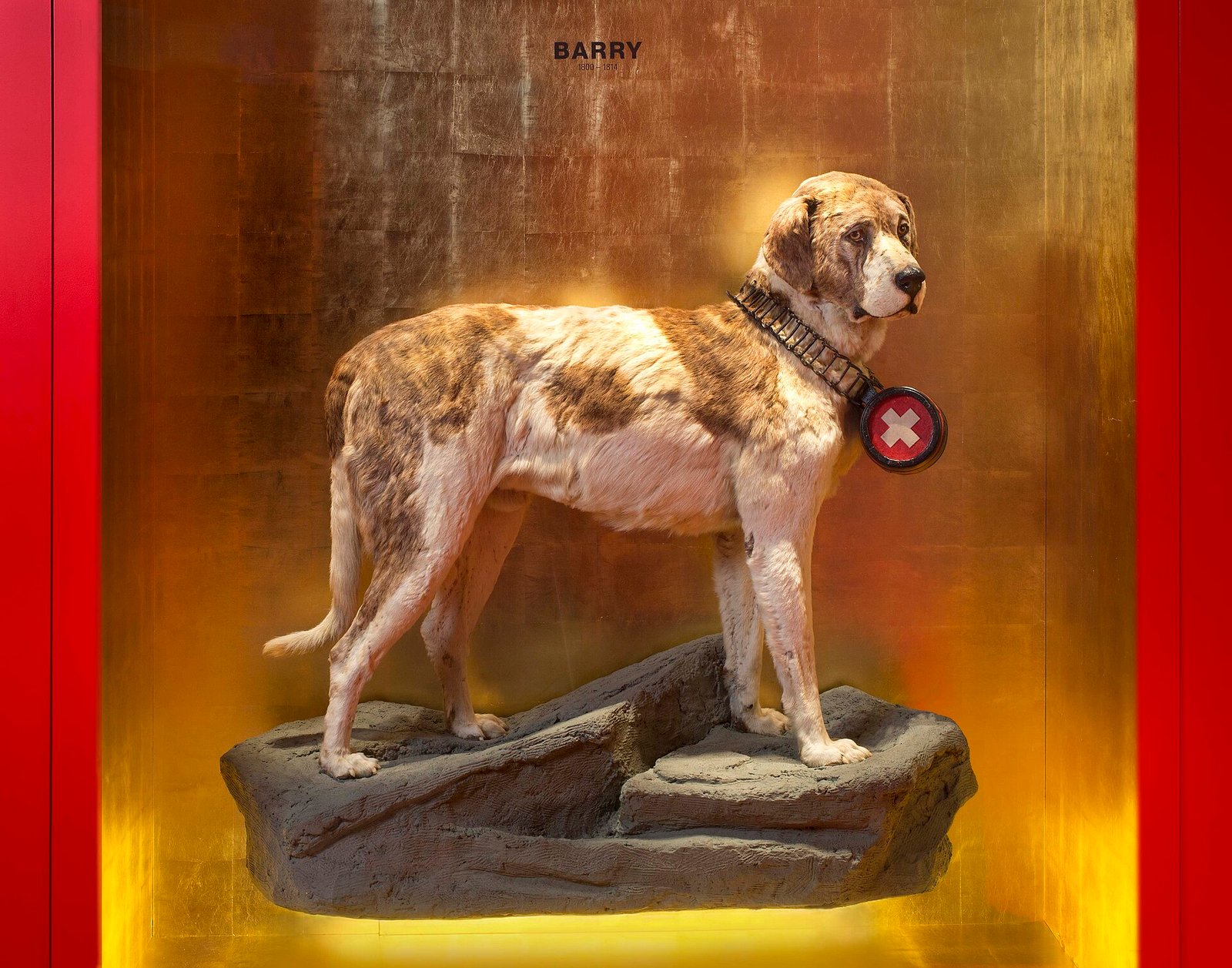
Bern, 1923. In the Natural History Museum, a dog who died more than a century earlier is being remade. His legs are lengthened. His head is reshaped to look like a modern St Bernard. His name is Barry. [1]
Forged in function
Canons, servants and dogs.
Augustinian canons have run the hospice on the Great St Bernard Pass since the eleventh century, almost 2,500 metres above sea level. Crossing was dangerous in any season: travellers got lost or trapped in snow. The canons and their servants went out to find them, and over time they began taking dogs along. [3] [2]
Large mountain dogs were kept at the hospice from the mid-seventeenth century to guard and protect it, and they are documented there by the early eighteenth century. The breed standard and the Barry Foundation give 1707 for the first written record; the foundation’s Barryland site gives 1708. [2] [7] [6]
These were not avalanche dogs in the modern sense. Bern’s museums describe their main job as guiding people back to the hospice through heavy blizzards. Rescue was teamwork between people and dogs, not a lone dog on a mission. [3]
The real Barry
Twelve years on the pass.
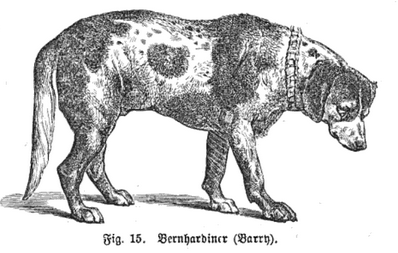
Barry was born in 1800 and worked at the hospice until 1812. He was famous even in his lifetime. The Barry Foundation says he saved more than forty people. That is a traditional figure, not an audited record of rescues, and the foundation’s own Barryland site says his story mixes fact, myth and legend. [4] [5] [3]
In 1812 Barry was retired to Bern, where he was cared for until he died in 1814. He did not die on the mountain. The following year his preserved body went on display at the Natural History Museum in Bern. [4] [1]
The myth machine
Longer legs, a new head and a barrel.
Barry’s mount was reworked in 1826 and again in 1923. The 1923 rework lengthened his legs, so the worn patches of fur no longer sit at his elbows where they belong, and reshaped his head to look like a later St Bernard. A museum reconstruction for his 200th birthday showed that the head does not match his preserved skull. The mount shows what people expected Barry to look like, not his size in life. [1]
The best-known Barry story, that he found a lost child and carried it to the hospice on his back, is described by the Swiss National Museum as largely legend. Even its details change from telling to telling. [1]
The barrel came from art. Sir Edwin Landseer’s 1820 painting Alpine Mastiffs Reanimating a Distressed Traveler shows one dog with a small barrel at its collar. The National Gallery of Art credits Landseer with spreading the myth that St Bernards carried brandy kegs, and says the story is not true. The Swiss National Museum adds that a barrel would only have got in the way of a working rescue dog. [8] [9] [1]
From hospice to standard
The breed gets its paperwork.
In 1867 Heinrich Schumacher of Holligen, near Bern, began issuing pedigree certificates for his dogs. The Swiss stud book opened in February 1884, and its first entry was a St Bernard named Léon. The Swiss St Bernard Club was founded in Basel on 15 March 1884, and on 2 June 1887 an international congress recognised the breed as Swiss and made its standard binding. [2] [7]
Today’s FCI standard sets heights of 70–90 cm for males and 65–80 cm for females, and does not penalise taller dogs if they are balanced and move soundly. That is a modern standard. It should not be projected back onto Barry or the early hospice dogs. [2] [1]
The hospice line continues. Since January 2005, the Barry Foundation has run the kennels and breeding that the canons of the Great St Bernard once kept. [5]
Living with the history
Health, care and the right home.
A very large dog
The modern standard describes a giant dog. Before choosing a puppy, ask which health screening the parents have had and see the actual results, then plan with a veterinarian for the care and costs that size brings. [2]
Two coats
The standard recognises short-haired and long-haired varieties. Both have plenty of undercoat, so plan for regular grooming. [2]
Best owner
Someone with the space, time and budget for a very large dog, who wants a companion rather than a legend.
Worst mismatch
A home expecting the rescue myth, or the barrel-carrying icon, to stand in for training and care.
Prints & provisions
The Kit
The Medallion
A matching T-shirt is not yet available to order.
As an Amazon Associate, Barking Past earns from qualifying purchases. Affiliate purchases may earn us a commission at no additional cost to you. This page is general breed information; discuss your own dog’s health with your veterinarian.
Sources & further reading
- Swiss National Museum blog — Ein Retter auf Reisen (Barry’s mount and legends)
- Fédération Cynologique Internationale — St. Bernard breed standard no. 61
- Bern museum district — Barry, Natural History Museum Bern
- Barry Foundation — About us
- Barryland — About us
- Barryland — Experiences and history
- Barry Foundation — History of the breed
- National Gallery of Art — Who was Sir Edwin Landseer? 10 things to know
- National Gallery of Art — Alpine Mastiffs Reanimating a Distressed Traveler (1820)
From the archive
Plates & context